Traveling is an important part of my life. And I have lots of precious moments, which I have experienced while visiting the remarkable places and meeting the incredible people. So, I decided to capture such bright memories and turn them into my blog posts, which I can look back on and share with others. Maybe, one day, these short stories will inspire some people to begin their own truly meaningful and exciting adventures...

Sunday, 6 October 2019

Italy, Incisa in Val d'Arno

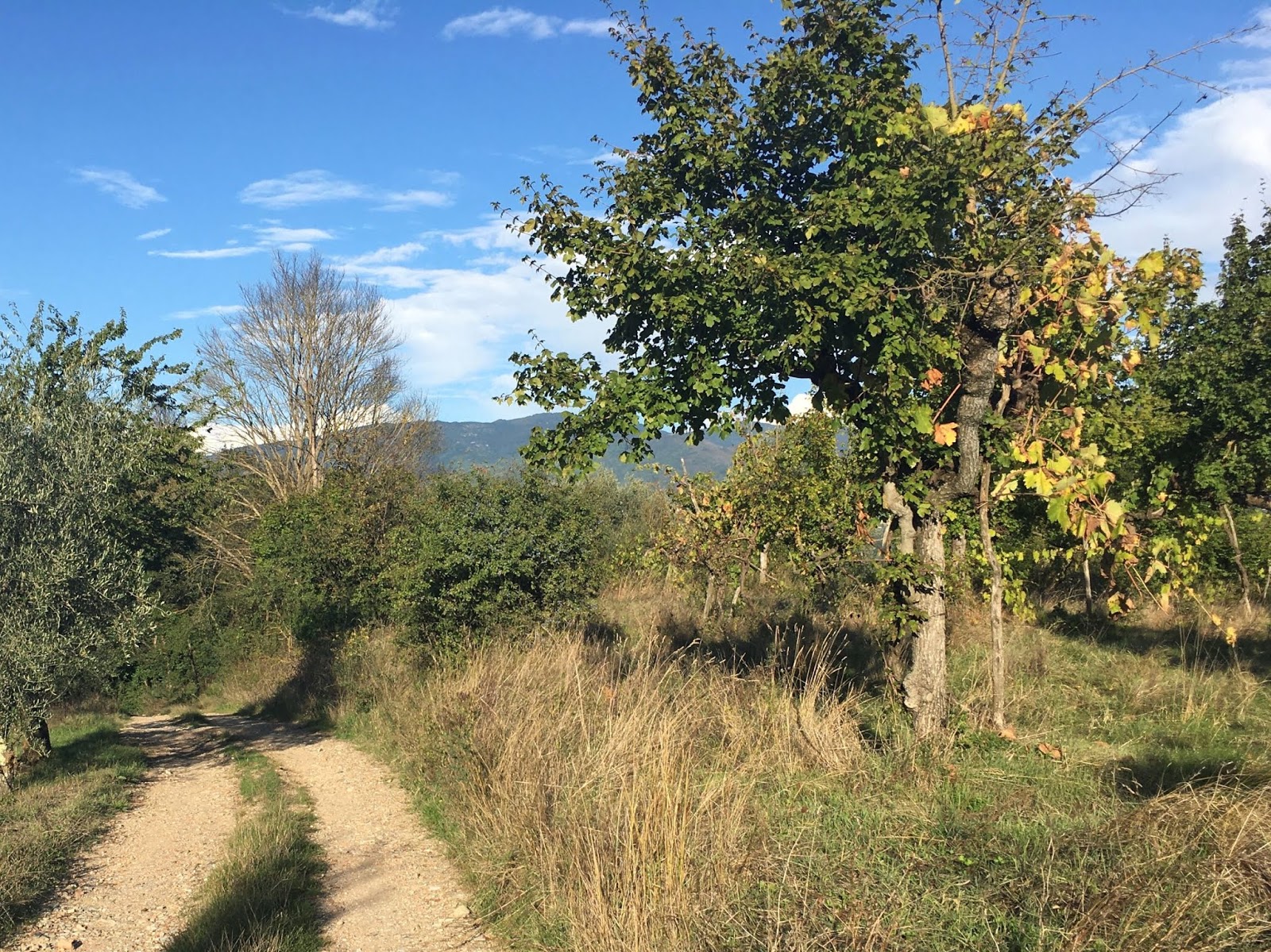
The valley of ValdarnoThe country road somewhere in Incisa, Italy

This is going to be quite a long trip to the next place of my temporary stay. First I go to Empoli, then I move to Florence, and finally I arrive to Incisa.

Empoli railway stationThe railway station in Florence

Well, the train from Empoli to Florence was fully loaded. So many people want to see this magnetic birthplace of the Renaissance.
When I stopped at Florence for a while, I met the numerous crowds of enchanted tourists. Honestly, I got used to the solitude while living in the 'rural' villages of Tuscany, and now I feel rather uncomfortable at this vibrant city.

Incisa station

It is only 20 kilometres from Florence to Incisa. In fact, it was the first time when they checked the ticket on the train. Fortunately, I was rational enough to buy one.

Incisa is such a small but charming town with the population of 6 thousand people. Still, it looks rather vivacious, and there are several good restaurants here.

Incisa view

The street of IncisaIn Incisa

The old church

Very easy I could locate my apartment, and very soon I got acquainted with my hostess Verena. All of a sudden, Verena offered to show me the surroundings, which she is really fond of. So, we made a long walk around the nearby hill and it took us roughly two hours.

First, I was quite skeptic to hear from Verena that we were going to see some spectacular scenery. Yet, there were some picturesque views, but it was not exceptional for me at all, because I still kept in mind the magnificent images of Bagni di Lucca.

Val d'Arno

Meanwhile, Verena discovered to me, that Incisa is known for its castle, which dates back to the 11th century, and also for the name of the Renaissance poet Petrarch, who grew up here. She was also saying something else about the history of the town, but I could not memorize her stories. Yet, Verena is really passionate and aware of the place she is living at now.

The old house of Petrarca's familyTerracotta pipes in the old house

The Petrarca's house

However, many people find this place interesting mainly because of the fabulous view on the Valdarno valley. And when we reached the higher point of the hill, I truly understood, why Verena appreciated this area and why we made this 'tiresome' walking.

The fabulous view of the Valdarno valleyThe fabulous view of the Valdarno valley

Indeed, there is something special about Incisa. It is close to Florence with its architectural gems, and at the same time there is a great opportunity to enjoy this spectacular landscape every day. I believe, it is a perfect location if you are looking for a comfortable place for living and enjoying your life at the slow pace.

The typical view of Toscana region

Saturday, 5 October 2019

Italy, Florence's rival

Il Campo squareTerracotta roofs of Siena city

Today I have decided to go to Siena. Honestly, I have never heard about this place before. However, many local people highly recommended to me visiting it. And it is located rather close to my temporary house. In fact, it is only 55 minutes by train.

Geographically, the city is situated in 70 kilometers from Florence, and it sits over three high hills on the height of 322 meters over the sea's level, between the rivers Merse and Arbia. The population here is about 55 thousand.

In the thirteenth century the Siena Republic was one of the wealthiest states in the whole Italy. It was the independent city-state of bankers and merchants. However, in 1348 it dramatically suffered from the plague, and one third of local people died. Eventually, in the fifteenth century Siena was conquered by another prosperous city of Florence, which had been its perpetual rival for many centuries.

So, I have arrived to Siena.

Many of the ancient walls from the eleventh century are still standing around the city. Nowadays, there are 12 remaining gates, that you can admire as you walk around its walls or through the historic centre. And I was lucky enough to pass through Porta Camollia, which is one of the most beautiful gates of Siena. You will hardly miss it if you arrive to the city by train. The most exciting detail of this door is the inscription on the arc, which states “Cor magis tibi sena pandit” meaning “Siena opens a bigger heart”.

The entrance to the old cityThe old gates of the old city

In general, the city looks like a labyrinth, because it is very easy to get lost here, especially if you do not see the main dominants of the city, which are the towers of The Town Hall and The Cathedral. The narrow streets of Siena are not planted with trees, but you can breath here easily due to the fact that they do not allow the cars enter the old town.

The old street of the Siena cityThe architecture of the old city

The old street of the Siena cityThe windows' shutters in the old house

Siena's heart is its central piazza known as Il Campo. It is one of the biggest medieval squares in the world, and it has an unmistakable peculiar shell-shape with circumference of 333 metres. Nowadays people are used to hanging out here as if they are on the beach.

Another remarkable feature is that the square is divided into 9 sectors. This planning appeared in the fourteenth century during the rule of the Council of Nine, when each section of this fan-like brick pavement represented the council. At the same time there was a tradition that during the city holidays or political discussions the citizens from 17 different quarters (or contradas) could occupy only their sectors according to their places of residence.

Il campo is also known for the famous Palio Horse Race run, which takes place here two times every year, on July 2 and August 16. By the way, you can see this event in one of the James Bond movies "Quantum of Solace".
So, there are 10 horsemen, who take part in the races, and each of them represents 10 out of 17 districts of the city. Riders wearing the medieval costumes and without saddles must complete three circles around the square; they are even allowed to push each other and throw the opponents off the horse. Each circle has a length of 333 meters, so, the horse racing lasts no more than 90 seconds.

Il Campo squareIl Campo square

While strolling around the city I have met many statues of the she-wolf suckling the infants. I knew that it was the symbol of Rome, but, as it turned out, it is also the symbol of Siena. Interestingly, the Sienna Wolf, unlike the Roman, does not look to the side, but forward.
According to the local legend, the brothers Aschius and Senius, the children of Remus, escaping from Romulus, took this image from the Roman house, which symbolized their lost fatherland. Finally, they have found a shelter on one of these Tuscan hills, where the city of Siena was later founded. Nowadays some people believe that Siena received its name after one of the survived brothers. 

She-wolf is the symbol of Siena cityThe statue of she-wolf can be seen in different parts of Siena

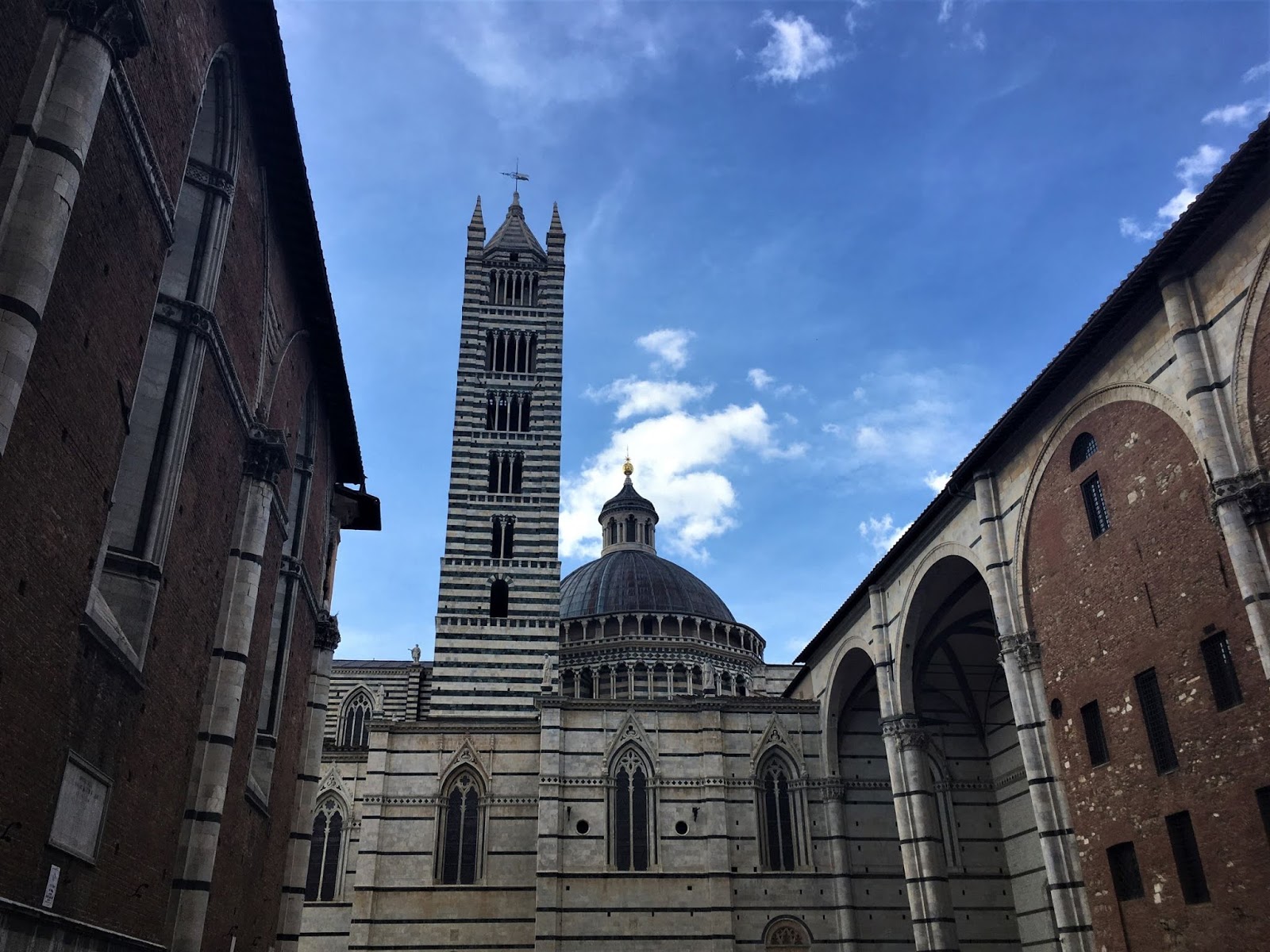
If Il Campo is the heart of Siena, the Cathedral (or Duomo) is its soul. The church of Santa Maria Assunta, build in the Gothic style, sits at the Siena's highest point, and it is visible for miles around.
The cathedral was designed and completed between 1215 and 1263. The exterior and interiors are decorated in white and greenish-black marble in alternating stripes, with addition of red marble on the facade. By the way, black and white are the symbolic colors of Siena, which are linked to black and white horses of the legendary city's founders, Senius and Aschius.

The cathedral of Siena

The cathedral of Siena

The cathedral of SienaThe main entrance of the cathedral

Undoubtedly, Siena is a glorious city with many attractions, but the most magnificent place here is its main square Il Campo, where I tried to stay for a while and spent the evening hours occupying the place at the local cafe.

Exit to Il CampoExit to Il Campo

I am really sorry to declare, but it is a big fortune for the modern tourists, that one day Siena has turned into a political and cultural outback. Thus since then the new buildings were almost not built here, and this fact somehow allowed the city to maintain its medieval appearance to the present day.

The bright Italian style

The old architecture

The outstanding architecture of Siena

Friday, 4 October 2019

Italy, The Town on The Hill

The view from the hillThrough the ancient wall

In the morning I went downstairs for the breakfast, where I met the head of the family Simona. There was a long conversation with the hostess on unknown to me Italian language, and I hardly could understand a word in her speech. But she was so natural and emotional, that I fall in love with that woman and all Italians as the nation. Another time I come to conclusion that staying at the local's house as a guest is the right choice while travelling abroad, because in that case you would have a chance to see ordinary people, to hear amusing stories, to get valuable tips and to experience genuine emotions.

Several facts from Simona I learnt very well. First, the Italian people prefer coffee not from the espresso machine, but from the geyser coffee maker, which originally was designed in Italy in 1933 ('la moka' in Italian). Second, cappuccino is being drunk only in the morning. Third, they call Americano not coffee with lots of hot water, but coffee with volume of double espresso. Lastly, my favourite Italian biscuits Cantucci are eaten not with coffee, as I thought before, but with the dessert wine, into which they are usually dunked.

Italian coffeemakerCantucci, the traditional Italian bakery

Simona also told me about the nearby places, which, in her opinion, I should visit by all means. One of such places is the small village of Vinci, famous for being the birthplace of Leonardo da Vinci (1452). Unfortunately, Vinci is not accessible by train, so I headed for the city of Certaldo, which is more convenient to reach.

On the way to the railway station I took time to observe the area of my temporary staying. In fact, my village is a really small and quite boring for young people community. One church, one cultural centre for the pensioners, one supermarket and a train station without a ticket machine are the only public places here. I even have not detected any restaurant here.

A country roadThe empty street of the secluded community

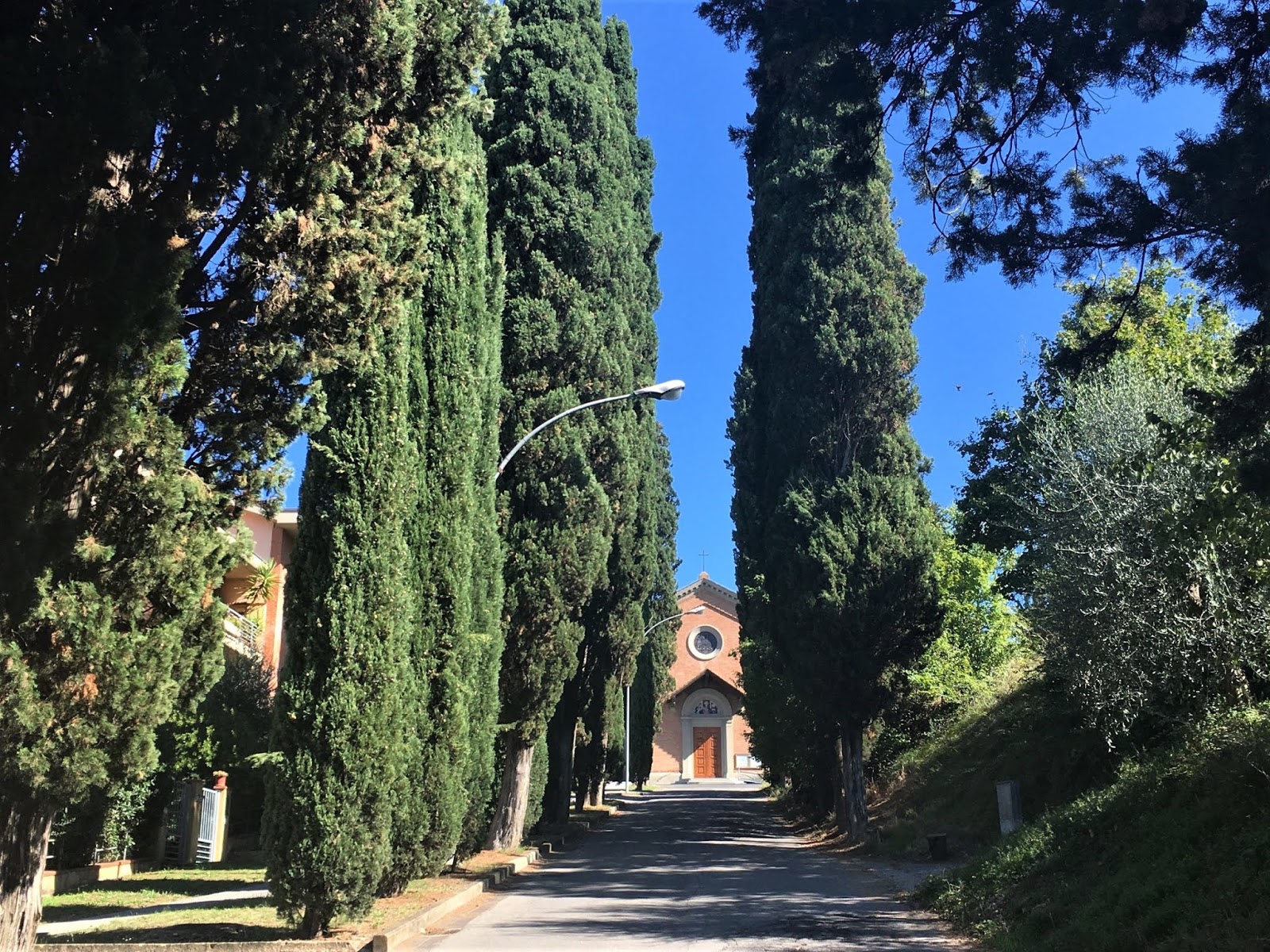
The cypresses along both sides of the road, leading to the churchA railroad

In 10 minutes by train I have arrived to Certaldo.

The town of Certaldo is divided into an upper medieval part called Certaldo Alto, surrounded by fortified walls, and a modern part located in the valley below. Of course, I was more interested in the historical part, and I  headed straight to the hill.

By the way, the name Certaldo originates from Latin, “altura ricoperta di cerri” and refers to a hilltop covered in trees.

Certaldo railway station

It is possible to access the old centre by climbing up the steep streets costa Alberti and costa Vecchia, from the more modern via del Castello, or by using the funicular railway that leaves from piazza Boccaccio. I have decided to save money and to perform a nice steeply walk.

The funicularLook down the hill

Reaching the old town on the hill The stone houses of the old town

Unlike many towns which are built around a main square, the limited space on the hilltop of Certaldo forced the town to grow along the main road, which is known today as Via Boccaccia. These days the main road serves as the stage where many of the historical reconstructions, folkloric events, markets, and town dinners take place.

A trading raw

Local products

The most remarkable building of Certaldo is the Palazzo Pretorio (or Palazzo of the Vicariato), and it is situated on the higher point of the hill of Certaldo.
In fact, the Palace was constructed in the 12th century, and it became the residence of the Florentine governors. On the facade of the Palace there are placed various coats of arms in marble, stone and ceramics. Them represent the families of the governors who were in the government of Certaldo. The largest coat of arms in the center of the facade is the Medici's. 

Via Boccaccia leads to the palacePalazzo Pretorio dates back to the 12th century

The Palace also encloses the interesting series of rooms where you can admire frescoes from the 15th and 16th centuries.

The inner yard of the palace

The old frescoes on the walls of the palaceThe old well

The old walls

Certaldo is connected with the name of Giovanni Boccaccio, one of the greatest Italian writers and poets. He was also recognized as the Renaissance humanist, scholar of classical literature, a friend of Petrarch and a great fan of Dante. However, most people know him primarily as the author of the tales series "Decameron", written between 1349 and 1351.
Boccaccio spent in Certaldo the last years of his life in a house, which can be visited today as a museum. He was buried in Certaldo in 1375.

The illustration to the Boccaccio's novelThe illustration to the Boccaccio's novel

Still, even if you are not interested in the name of Boccaccio and his heritage, his house is worth entering simply because of the grand view from the tower, which you can climb while visiting the museum.

View on the town of Certaldo from the tower

The Italian landscape

Selfie on the top of the towerThe roofs of the old houses

Next door to the palazzo stands the church of San Tommaso e Prospero, dating to the 13th century. But today it is occupied by the wine festival, which is holding in the town these days. Actually, it is called Boccaccesca, and it takes place the first two weekend in October. The purpose of this food festival is celebrating the local food traditions. As a matter of fact, Certaldo is also famous for the red onion, the white truffles and an excellent Extra Virgin Olive Oil, so you can try them together with other delicacies of the Tuscan gastronomy at this event. Moreover, it is an unique opportunity to taste good quality wine directly from the producer. This evening I have glassed Oblio wine from Poggio delle Civette company, and there were both variants - simple and superior one.

The wine fest

My favoritesDrinking and relaxing

After tasting superior wine I left the church and looked at the beautiful colours of the pre-sunset sky. At some moment I understood how 'dolce vita' feels like and why Tuscany could inspire many famous local people for their great achievements.

Italian viewsItalian landscape at sunset light

I was back home late at the evening. A little bit tired, but absolutely satisfied with everything I have seen and experienced today. Hardly can I imagine if the land of Tuscany may offer something better.

The narrow passage

The window

The old houses of Certaldo